

Have you ever had that gut feeling – an inkling, or a wave of emotion that seemed to point you in a specific direction?
That’s your Emotional Guidance System (EGS) at work – an internal compass designed to help you navigate life.
Your feelings are more than just reactions; they’re signposts showing you what path you’re on and where you might want to go next.
Let’s explore what the Emotional Guidance System is, how it works, and how you can use it to live a more aligned, fulfilling life.
What is the Emotional Guidance System?
Think of your emotions as the GPS of your soul.
Just like a GPS recalculates your route if you take a wrong turn, your feelings guide you toward alignment with yourself – your inner knowing, higher self, or simply the version of you that feels peaceful, joyful, and true.
When you feel joy, ease, or love, it’s a sign you’re moving in the right direction. You’re tune with well-being.
When you feel frustration, sadness, or overwhelm, those emotions are signals too – not punishments, but information. They highlight where something isn’t working and might need adjusting.
It’s not about labeling emotions as “good” or “bad.” Every feeling has a purpose.
- Uplifting feelings encourage you to keep going.
- Challenging feelings point you toward an adjustment.
The Emotional Scale
Think of your emotions as being on a scale – with joy and love at one end and fear or despair at the other. This concept has been popularized by teachers like Abraham Hicks, and you’ll find similar maps in psychology and in David Hawkins’ Map of Consciousness.
The idea is simple: emotions exist on a spectrum, from the most expansive (joy, love, empowerment) to the most contracted (fear, grief, despair).
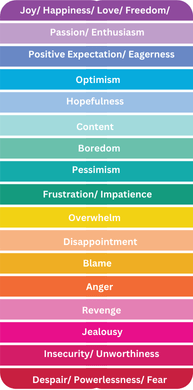
Here’s the key: you don’t have to leap from frustration straight to joy. That’s like expecting to climb a mountain in one jump.
Instead, focus on moving incrementally:
- From frustration → to hope.
- From hope → to optimism.
- From optimism → to contentment.
Each step brings a little more relief and helps you shift upward.
Listening to Your Feelings
Your emotions are constantly giving you feedback about your state and your alignment with yourself. Here’s how to start tuning in:
Pause and Feel
When you’re feeling off, pause and notice: What am I actually feeling right now?
Ask Why
What’s triggering this emotion? A situation, a thought, or a memory? Naming the “why” helps you respond with more clarity.
Seek Relief
Once you’ve identified your emotion, ask: What’s one small thing I can do or think about that feels just a little bit better?
For example:
- If you’re overwhelmed by a project → take a breath, write down the pieces, and choose one manageable next step.
- If you’re upset after a conversation → give yourself space. Journal, go for a walk, or ground in something soothing before revisiting it. Remind yourself you don’t have to solve it all right away.
The Power of Small Shifts
Imagine you’re stuck in traffic. Your first instinct might be frustration. But using your EGS, you could shift gradually:
- “At least I have a car and a comfortable seat.”
- “This gives me time to catch up on my favorite podcast.”
- “Maybe this is my reminder to slow down.”
It’s not about pretending traffic is amazing – it’s about reaching for the next best thought/ feeling. Over time, these micro-shifts add up, and you’ll notice your overall vibe rising.

Practical Ways to Tap Into Your EGS
- Daily Check-Ins → Ask: How am I feeling right now? What’s one thing that would feel better?
- Gratitude Practice → Noticing what you’re thankful for gently shifts your focus upward.
- Mindful Consumption → Pay attention to the media, conversations, and spaces you engage with. Do they lift you up or wear you down? Adjust accordingly.
- Visualize the Feeling → Spend a minute imagining peace, joy, or love. Let that sensation guide you back into alignment.
- Give Yourself Grace → It’s not about perfection. Progress is made in small, compassionate steps. Every small shift matters.
A Life in Alignment
Your Emotional Guidance System is always with you, quietly pointing you toward what feels good and true for you. By listening to your feelings and leaning toward what brings relief, you can create more ease, more clarity, and more joy.
So the next time you’re feeling off, pause and check in: What is your EGS trying to tell you?
Trust it – it knows the way.


 Good Things Publications
Leave a reply to Choosing Happiness Anyway – Good Things Publications Cancel reply